For queries, return and refund requests, we aim to respond to all emails within 1-3 days. Please reach out to us directly at contact@needohshop.au
Real vs Fake NeeDoh in Australia: How to Spot a Counterfeit Before You Buy
NeeDoh’s popularity in Australia has brought an unwelcome side effect: a flood of counterfeit versions sold through online marketplaces and unofficial sellers. With genuine stock selling out fast at Kmart, Big W, and other Australian retailers, more shoppers are turning to Temu, AliExpress, and unfamiliar online sellers to find one — and that’s exactly where the fakes are concentrated.
This guide explains exactly how to tell a real NeeDoh from a counterfeit, what the fakes actually look and feel like, and why it matters far more than just getting a lesser toy.
Why this matters more than it seems
It’s tempting to think a fake NeeDoh is simply a cheaper, slightly worse version of the real thing. It isn’t. Counterfeit toys aren’t subject to the same safety testing as authentic products, and the materials used can contain harmful substances that have no business being in a children’s toy. The construction is also often weaker, making fakes more prone to splitting open and exposing the filling inside — a genuine safety concern, not just a quality complaint.
So the stakes of buying a fake NeeDoh in Australia aren’t just “did I get ripped off.” They’re “is this safe to hand to my child.”
The logo and packaging test
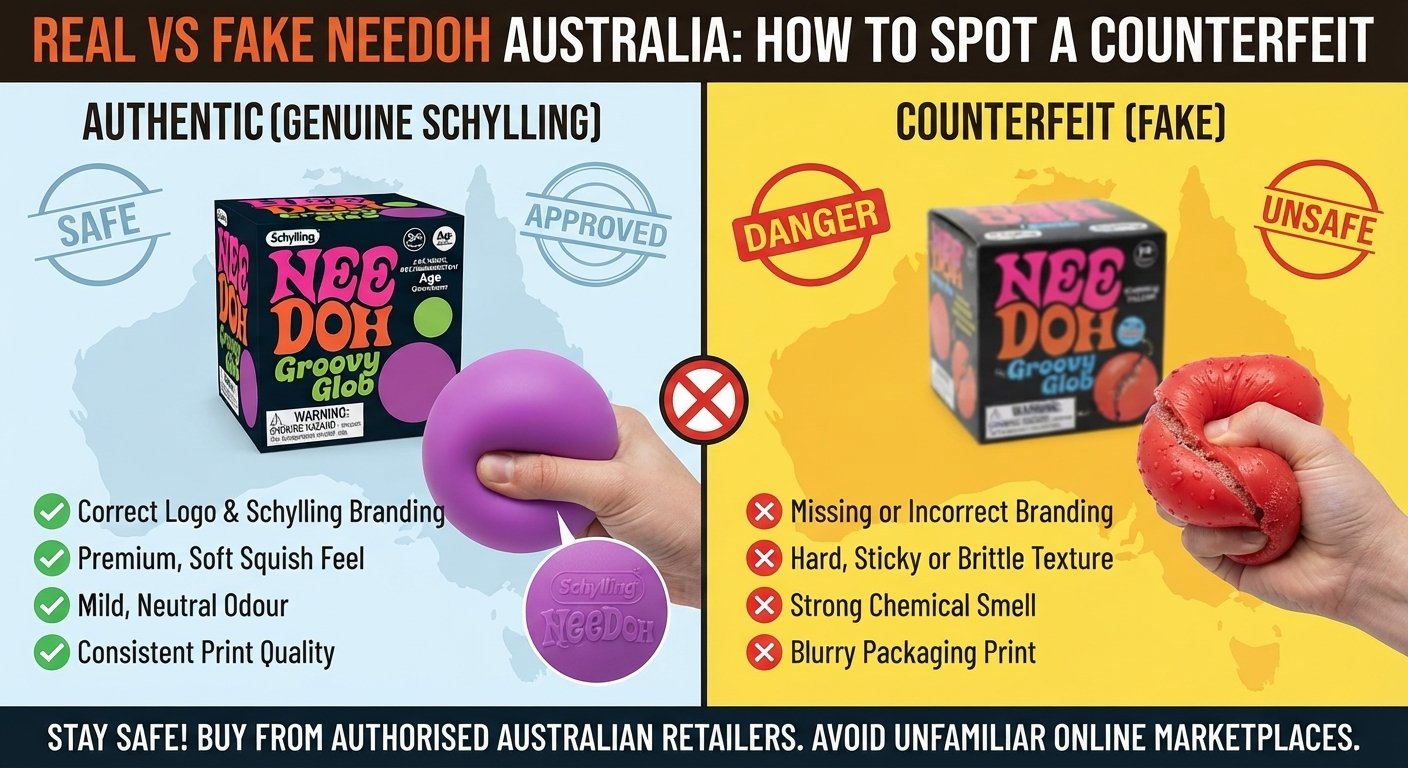
The single most reliable check is also the simplest: look for Schylling on the box. If the packaging shows a squishy toy that looks like NeeDoh, uses similar colours, and copies the general style — but the brand printed on it isn’t Schylling — it is not an official NeeDoh, regardless of what name is printed elsewhere on the packaging.
Genuine packaging is consistent and high quality: clear NeeDoh and Schylling branding on the front, an age mark, a choking hazard warning, and consistent print quality throughout. Fakes tend to give themselves away through blurry print, a spelling slip in the logo, or a missing safety panel. If you’re buying online, look closely at every photo in the listing — a stock image proves nothing about the actual box that will ship to you.
It’s also worth checking many full-size NeeDoh toys for a moulded or embossed NeeDoh mark directly on the product itself. On fakes, that embossing is frequently the wrong size, positioned oddly, or missing entirely — something to check on the toy, not just the box, before you commit to a purchase.
The texture test
If you can feel the product before buying — in person, or by asking a seller for a video — this is where fakes are hardest to hide. A genuine NeeDoh has a specific, engineered squish: firm and satisfying, sometimes described as a “memory foam” feel, giving gradually under pressure and returning cleanly to its original shape.
Counterfeits consistently fail this test in one of two ways. Some feel too hard and rubbery with a fast, snappy return that lacks any of the slow, satisfying give of the real thing. Others go the opposite direction — too soft, sticky, or “jelly-like,” sometimes with a grainy or lumpy filling that moves unevenly under your fingers. If the squish doesn’t feel right, it almost certainly isn’t right.
The smell test
This one surprises people, but it’s one of the most commonly reported red flags among buyers who’ve been caught out by a fake. Authentic NeeDoh has a very mild, close to neutral smell. Counterfeits frequently carry a strong, acrid chemical odour — described by buyers as smelling like spray paint, petrol, or industrial rubber.
That smell isn’t incidental. It’s a sign the compound inside hasn’t been through the same safety testing as genuine NeeDoh, and it’s a legitimate reason to avoid giving the product to a child, or to return it immediately if you’ve already bought it.
The price test
Price is one of the clearest tells of all, and it cuts in a direction many buyers don’t expect. Authentic NeeDoh holds fairly consistent retail pricing across legitimate stores. When a listing offers NeeDoh at a price dramatically below what you’d pay at a recognised Australian retailer, that discount isn’t a bargain — it’s the clearest signal available that you’re looking at a counterfeit. Genuine stock, when it’s scarce, tends to hold or even exceed normal pricing through legitimate retailers rather than undercutting it.
Where fakes come from
The pattern is consistent worldwide, and Australia is no exception. The vast majority of counterfeit NeeDoh products move through unauthorised third-party sellers on marketplaces like Temu, AliExpress, and unofficial eBay listings, rather than through recognised retailers. NeeDoh does not sell directly from overseas factories to the public — any listing implying a direct-from-manufacturer deal at a steep discount should be treated with real suspicion.
This is exactly why sticking to known Australian stockists — Kmart, Big W, Toyworld Australia, Mr Toys, and similar established retailers — is the safest path. These stores source through legitimate distribution channels, which is the single strongest protection against ending up with a fake.
What to do if you’ve already bought a fake
If a NeeDoh arrives and something feels off — the smell, the texture, the packaging, the branding — don’t give it to a child until you’re confident it’s genuine and safe. Contact the seller or platform for a refund based on the item not matching its description. If you bought through a major online marketplace, most have buyer protection policies covering items that arrive significantly different from what was advertised, including counterfeits — it’s worth checking the specific policy of wherever you purchased.
The bottom line
The surge in NeeDoh’s popularity across Australia has brought a genuine counterfeit problem alongside it, and the fakes aren’t just a lesser toy — they can carry real safety risks. Check for Schylling branding on the box and moulded into the product itself, trust your hands on the texture, be wary of any strong chemical smell, and treat suspiciously low prices as a warning rather than a win. Buying from established Australian retailers rather than unfamiliar online marketplaces remains the safest way to guarantee you’re getting the real thing.
A genuine NeeDoh is worth the wait. A fake one isn’t worth the risk.